

40mm · Street tune
PM-O801-0
Stock-spec 2.0–2.4L drivers wanting a factory-correct, tractable street tune.

Sizing, jetting, fitment and install — pick the correct triple-throat kit the first time.
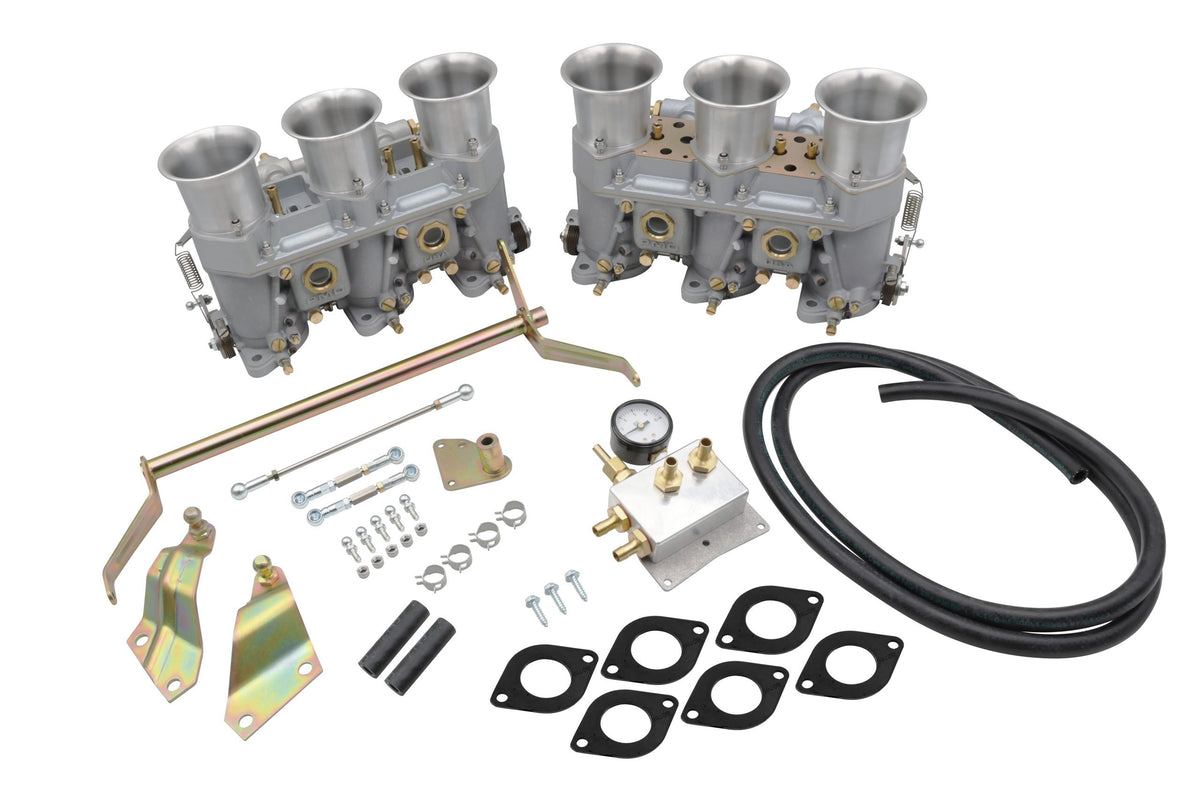
Triple-throat, IDA-style carburetion built to hold tolerances the originals never could.
PMO has built its reputation since 1997 as the specialist brand for triple-throat, IDA-style carburetion on air-cooled Porsche flat-six engines. Manufacturing is now carried out in Anaheim, California under the "PMO Induction" name, using aerospace-grade billet materials and permanent-mold casting for tolerances the original 1970s-era Weber IDA carburetors were never built to hold.
Every PMO kit is a matched pair of triple-barrel carburetors — three throttle bores per carburetor, one throat feeding each cylinder, six throats total across the pair. That one-throat-per-cylinder layout is what gives a properly tuned flat-six its crisp throttle response and even cylinder-to-cylinder fueling, but it only works if the carburetor itself holds its tolerances over time. That's where PMO earned its reputation over the carburetors it replaced.
The upshot for a shop or an owner: less chasing an idle that won't hold, less rebuilding worn shaft bores, and a carburetor that's actually built to be re-tuned as your engine combination changes — cam, compression, exhaust, or displacement.
Machined and micro-polished to .002" tolerance — the single biggest failure point on an original Weber IDA, where shaft wear creates vacuum leaks, an inconsistent idle, and a tune that drifts over a season.
Sealed ball bearings and Belleville spring pre-load keep the throttle shaft radially and axially located, so the bore stays round and sealed instead of slowly wallowing out.
On each carburetor — you can verify float level at a glance instead of partially disassembling the carb the way you have to on an original Weber.
Replaces the Weber's leak-prone banjo-bolt fitting with a higher-flow, better-sealed connection.
Weber's largest OE bore topped out at 46mm. PMO's 50mm kit exists specifically for big-bore, high-compression, and stroker flat-six builds that outgrow everything Weber ever offered.
Built for the air-cooled Porsche flat-six family — and spec'd against your engine, not your title.
The core PMO application, from early 2.0L cars through the 3.0L SC era and beyond.
Six-cylinder 914 chassis running the same triple-throat induction layout.
Carbureted conversions and built engines moving away from factory injection.
The last of the air-cooled cars, typically on race and heavily built combinations.
Every kit is built to order against your engine's actual specs — talk to us about your chassis and engine combination before you order so we can confirm the right kit, manifold, and linkage package. Washburn's also fields questions from the VW Type 4-based flat-four hot-rod build community — if that's your project, talk to us before you order so we can help confirm the right manifold and linkage package for your specific engine.
Two mechanical notes worth planning around before you install: cars built after 1974 generally need an exhaust system suited to open velocity-stack triple-throat induction, and distributors with vacuum advance (common from roughly 1971 onward) typically need to be re-curved — sometimes rebuilt — to match the vacuum signal behavior of a triple-throat carburetor versus the factory setup. Flag both with us before you order so your kit is spec'd correctly, and loop in your engine builder or installer of choice to handle the actual work.
All eight factory-matched PMO configurations Washburn's stocks, by throttle bore and displacement.
Stock-spec 2.0–2.4L drivers wanting a factory-correct, tractable street tune.

2.4–2.7L engines with a performance cam and/or bumped compression.

2.8–3.0L engines with performance cam/compression that outgrew the 40mm street tune.
3.2–3.4L with a performance cam and/or raised compression.
Stroker and race-spec 3.6–4.0L+ engines needing maximum airflow.
Two variables decide your kit, not one: bore size tracks how much air your displacement needs to breathe, while Street vs. Performance vs. Race tune tracks how you actually run the car — a lower-compression, mild-cam daily driver wants a leaner, more tractable street jet, while a higher-compression performance or stroker build needs a richer curve to stay safe at wide-open throttle. Not sure which column you fall into? Run the numbers below, or send us your cam and compression specs and we'll confirm before you order.
The same three variables PMO's own Carb Setup Sheet asks for, plus elevation.
What has to be right before the carbs go on, and what to check after they do.
Open velocity-stack induction changes both backpressure and vacuum signal versus the factory setup — sort your exhaust and distributor curve before you bolt carbs on, not after.
PMO's integrated sight glass lets you set and verify fuel level on the bench and again once the engine's warm, with the tank at a realistic level — no partial teardown required. A float level gauge makes this a one-minute check.
Use a flow-balance (Unisyn-style) gauge at idle and again at a steady 2,500–3,000 RPM — we stock a PMO syncrometer for exactly this. An out-of-sync bank shows up as a lopey idle and uneven cylinder temps long before it shows up on a dyno sheet.
The idle jet controls roughly idle through 1/8 throttle — adjust only once the engine is at full operating temperature.
Main jet governs roughly 3/8 throttle to wide open; air correction jet shapes the transition and top-end enrichment curve. A few heat-cycled full-throttle pulls followed by a plug read is still the most reliable way to confirm the main jet for your exact combination and elevation.
Linkage settles and gaskets seat in the first few hundred miles — plan a follow-up sync and mixture check, not just a one-time setup.
Everything above is easier with the right tool on the bench. These are the PMO service items we keep on the shelf.

The airflow gauge for step 03 — balances all six throats at idle and at cruise RPM. Made in Germany; works on PMO and Weber carburetors alike.
View product →
Turns step 02 into a one-minute check. Sets and verifies float height against the sight glass without pulling the carburetor apart.
View product →
Spare mains, air correction and idle jets so you can chase a plug read the same afternoon instead of waiting on an order.
View product →
Adjustable regulator with barbed fittings. Carburetors want low, steady fuel pressure — an unregulated pump is a common cause of a float level that won't stay put. An AN-6 version is also stocked.
View product →
Gaskets, seals and diaphragms for 40mm, 46mm and 50mm PMO sets — the refresh that goes with the post-break-in re-check in step 06.
View product →
Standard 3.25" element. Open stacks look the part, but a filter is what keeps grit out of precision-drilled jets.
View product →We spec it before we sell it — because a re-order costs more than a phone call.
Washburn's Metal is a shop of air-cooled Volkswagen and Porsche owners and specialists based in Orange, California. Sheetmetal restoration and fabrication are what we do with our hands — we're not an engine shop, and we don't turn wrenches on your motor. What we bring to PMO carburetion is the same thing we bring to everything else we sell: we live in these cars, we know them inside and out, and we make sure you're ordering the exact right kit before it ships. We stock all eight factory PMO kit configurations, from the 40mm 2.0–2.4L street kit through the 50mm 3.6–4.0L race kit.
As air-cooled owners ourselves, we know the questions a parts counter won't think to ask: whether your distributor needs re-curving, whether your current exhaust will actually support open velocity stacks, and whether your "3.0L" is really making the compression and cam profile you think it is. Get that right before the kit ships and you skip an expensive re-order — then hand the install off to your engine builder or installer of choice.
The questions we field most often before a kit ships.
Bore size follows your engine's total displacement and how much air it needs to move, not the model year on your title. As a starting point: 40mm typically covers 2.0–3.0L, 46mm covers 2.8–3.4L, and 50mm covers 3.5L and up or heavily built engines. Use the calculator above for a specific recommendation, or send us your displacement, cam, and compression and we'll confirm.
Same throttle bore, different jetting curve. A Street tune is calibrated for a stock or mild-cam engine at stock-ish compression — tractable idle, good part-throttle manners, daily-driver friendly. A Performance tune assumes a hotter cam and/or higher compression that needs more fuel at wide-open throttle to stay safe. Pick based on your actual cam and compression, not your ambitions.
In many cases, yes — especially on cars built after 1974. Open velocity-stack triple-throat induction changes backpressure characteristics versus the factory intake and exhaust, so it's worth confirming your current exhaust is compatible before your kit ships.
If your car has a vacuum-advance distributor — common from roughly 1971 onward — it typically needs to be re-curved, and sometimes rebuilt, to match the vacuum signal of a triple-throat carburetor setup correctly. Plan for this alongside the carburetor install, not as an afterthought.
Yes. Less oxygen per unit of air at altitude means a sea-level jet will run rich once you climb — main jet and air correction jet both typically need to come down to compensate. It's one of the inputs on PMO's own Carb Setup Sheet, and it's built into the calculator above.
PMO builds every kit to order against your Carb Setup Sheet — displacement, cam, compression, exhaust, and elevation — so it arrives close to correct for your specific combination. Expect to fine-tune idle mixture and confirm the main jet with a plug read once the engine's broken in and fully warmed up; that's normal for any carbureted induction system, not a sign anything's wrong.
Each kit is a matched pair of triple-barrel carburetors with a ported intake manifold set, insulator flanges, crossbar throttle linkage, fuel line, fuel filter, and hardware. Air cleaners are typically offered separately (standard or short-body for A/C-equipped cars) — check the individual kit page or ask us to bundle one in.
Since every kit is built to your Carb Setup Sheet, lead time varies with current order volume — contact us for the current estimate on your configuration. Washburn's specializes in sheetmetal restoration and fabrication, not engine work, so installation, exhaust prep, and final tuning are handled by your engine builder or installer of choice. If you need a recommendation, ask — we're happy to point you in the right direction.
Tell us your displacement, cam, and compression and we'll confirm the right PMO kit before you order — or browse the full lineup now.